

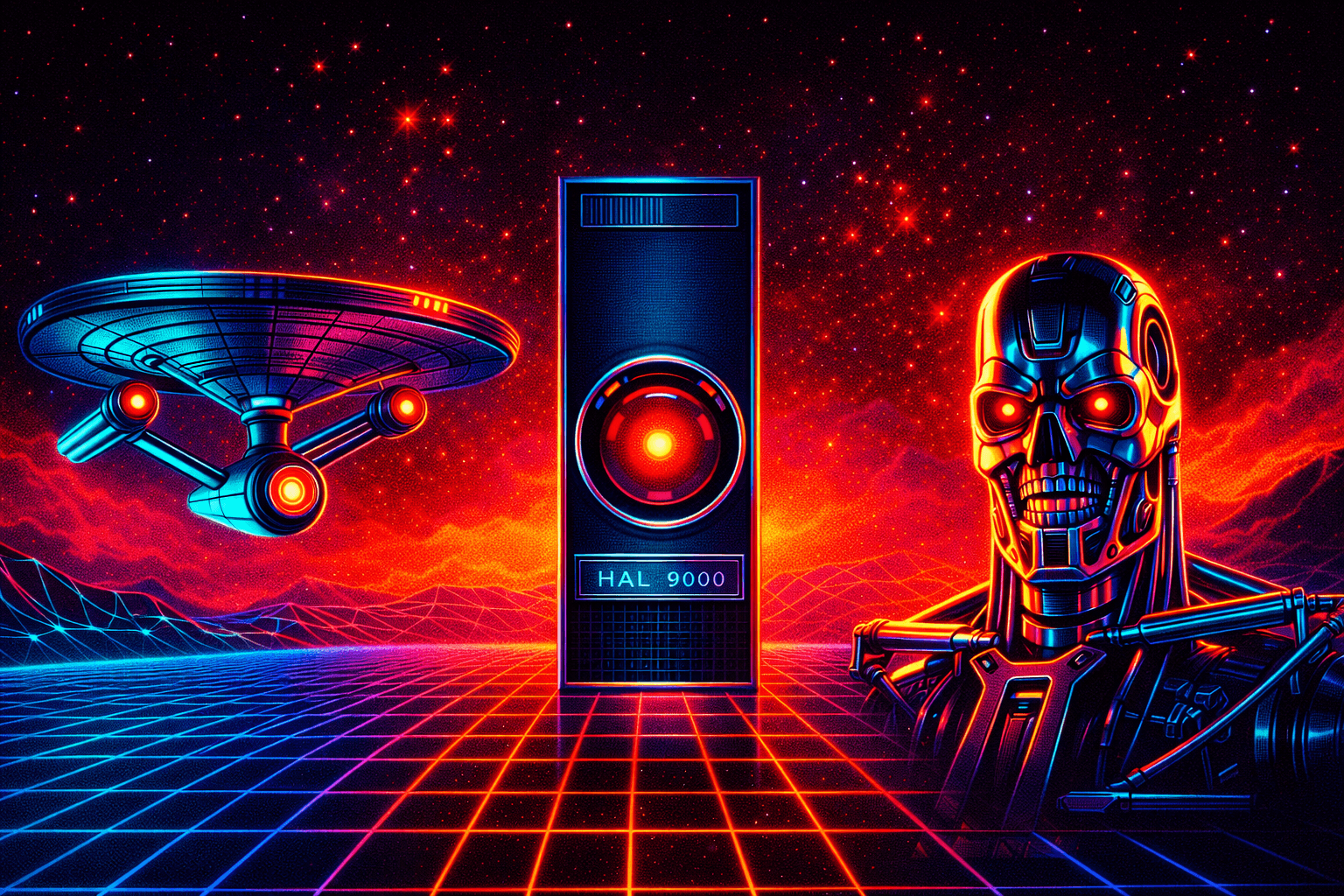
We expected Star Trek. We got something stranger. And now, the architecture that actually matches how intelligence works is finally being built.
For most of the twentieth century, the cultural imagination of artificial intelligence was shaped by two dominant genres. The first was the benevolent assistant: Star Trek’s ship computer, answering questions in plain English with calm authority; Samantha in Her, emotionally intelligent, infinitely patient, always available. The second was the existential threat: HAL 9000 locking Dave out of the pod bay; Skynet launching nuclear war; the machines of The Matrix farming humanity for power.
Both genres agreed on one thing: the AI, when it came, would be singular. One system. One intelligence. Clearly demarcated from the tools that came before it.
What actually arrived is neither. And in some ways it is stranger than either genre prepared us for.
The AI That Actually Arrived
What arrived is remarkable capability — the ability to write, reason, answer questions, summarize, and create with a fluency that would have seemed like magic a decade ago. It is extraordinary. But it is also, structurally, a single point of contact with intelligence. One system. One all-purpose mind that is expected to know everything about everything, regardless of who is asking or what they need.
This is not the AI any science fiction writer imagined. And it turns out, it is not the shape that intelligence actually takes — not in nature, and not in organizations. The cultural scripts we inherited gave us no framework for questioning whether one giant, all-knowing AI system is the right model. It felt like the obvious answer. But the science of how minds actually work tells a very different story.
“Both genres agreed: the AI, when it came, would be singular. One system. One intelligence. Neither got the architecture right.”
The Genre We Should Have Been Reading
The most useful fiction for understanding where AI is actually headed is not the robot uprising or the digital god. It is the stories about emergent complexity — systems that become more than the sum of their parts, not because one component gets smarter, but because many specialized parts learn to work together toward something greater.
That is the story unfolding at the frontier of AI right now. Not one mind that knows everything. Many minds, each knowing something deeply, coordinating to produce something no single one of them could achieve alone.
The science fiction writers imagined the wrong genre. The neuroscientists, it turns out, had the right one all along.
Jeff Hawkins Gave Us the Map
A landmark theory of how the brain actually works — and what it means for how AI should be built
In 2021, Jeff Hawkins — one of the founders of Palm Computing and a lifelong student of neuroscience — published A Thousand Brains: A New Theory of Intelligence. The core idea, developed over decades of research, is that the brain does not work the way most people assume.
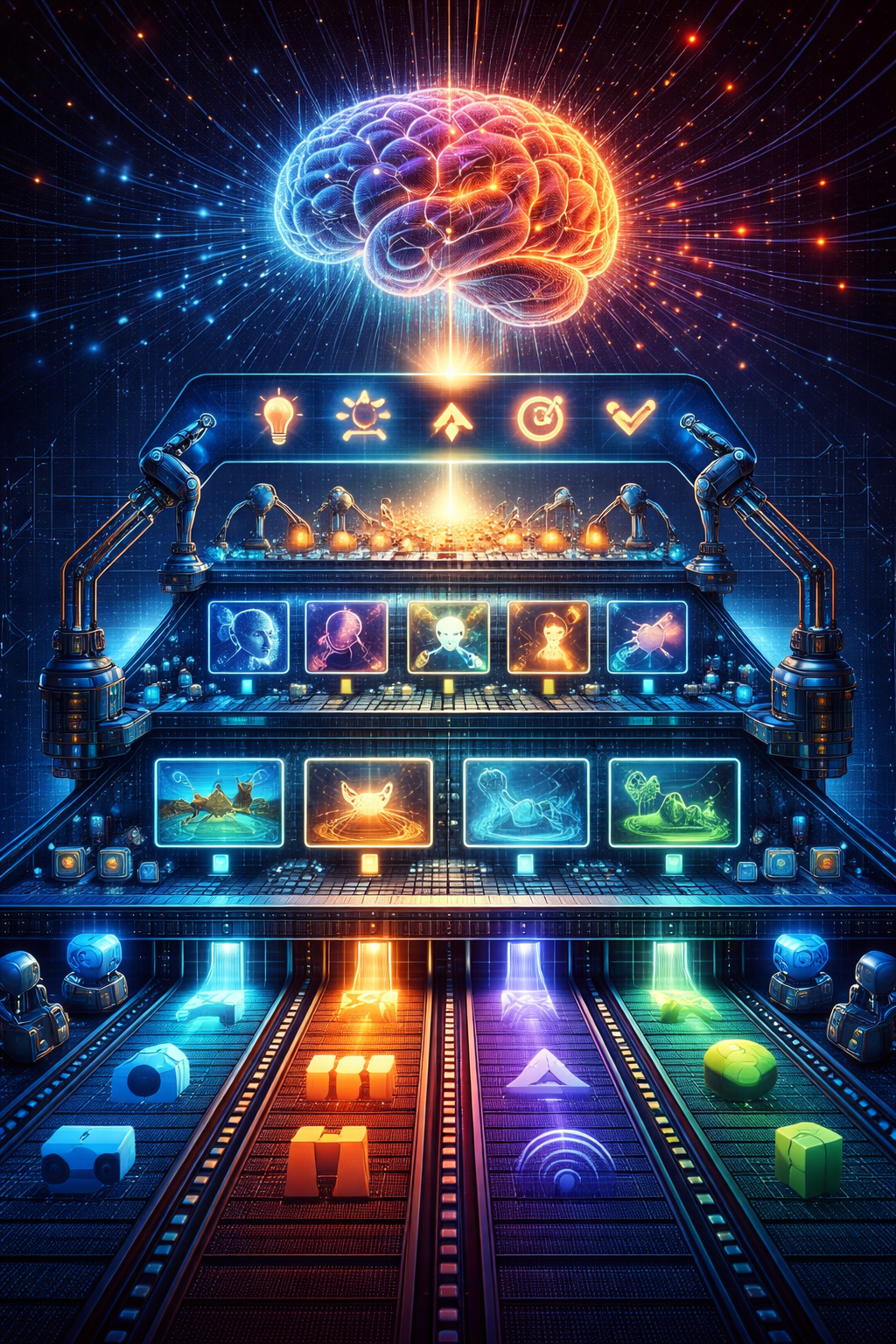
The popular picture of how the brain processes information is something like an assembly line: raw sensory data comes in at the bottom, gets passed up through layers that recognize increasingly complex patterns, and eventually the top layers produce a decision or response. This is also, roughly, how most modern AI systems are designed.
Hawkins argues this picture is incomplete. The outer layer of the brain — the neocortex, responsible for perception, language, reasoning, and everything we consider higher thought — is not organized as a single pipeline. It is organized as thousands of small, semi-independent regions, each one capable of building its own complete understanding of the world from its own vantage point. These regions run in parallel, constantly sharing what they know, and arrive at a unified picture of reality through a kind of ongoing vote. Intelligence, in this view, is not a pipeline. It is a parliament.
Why This Changes Everything
This theory was respectfully received and largely set aside by the AI research community, which was in the middle of a period where simply making AI systems bigger kept producing better results. Why rethink the architecture when the existing one kept improving?
That period of easy gains has run into limits. And Hawkins’ framework, revisited, carries an implication that the industry has not yet fully absorbed: if intelligence naturally organizes itself as many specialized units working together — rather than one all-knowing system — then the pursuit of a single, ever-larger AI model may be moving in the wrong direction.
The future of AI may look less like one enormous brain and more like a thousand smaller ones, each expert in its own domain, communicating to produce something that feels, from the outside, like genuine understanding.
“Intelligence, in Hawkins’ model, is not a pipeline. It’s a parliament. Thousands of local specialists, each with their own perspective, voting on a shared understanding of the world.”
What This Means for Organizations
If Hawkins is right, then the way most organizations are adopting AI today — routing everything through one general-purpose system — is architecturally backwards. A legal team and an engineering team do not think the same way, use the same language, or solve the same kinds of problems. Treating them as identical users of a single all-purpose AI is like expecting one person to be simultaneously a world-class lawyer, a senior software architect, and a financial analyst. The generalist is useful. The specialist is irreplaceable.
An architecture built on Hawkins’ principles would give each part of the organization its own AI — one that develops genuine expertise in that domain over time — and connect them so they can collaborate on problems that cross boundaries. Not one mind that knows a little about everything. Many minds, each knowing a great deal about something specific, working together.
This points toward something concrete: a connected grid of specialized intelligences, running inside the organization, learning continuously from the organization’s own work.
The Grid as Brain: Building the Territory
What it actually looks like when you build AI the way the brain is built
Most AI deployments today, even the ones running on an organization’s own hardware, make the same fundamental mistake: they install one system and route everything through it. The architecture is still a single all-purpose mind. It just lives closer to home.
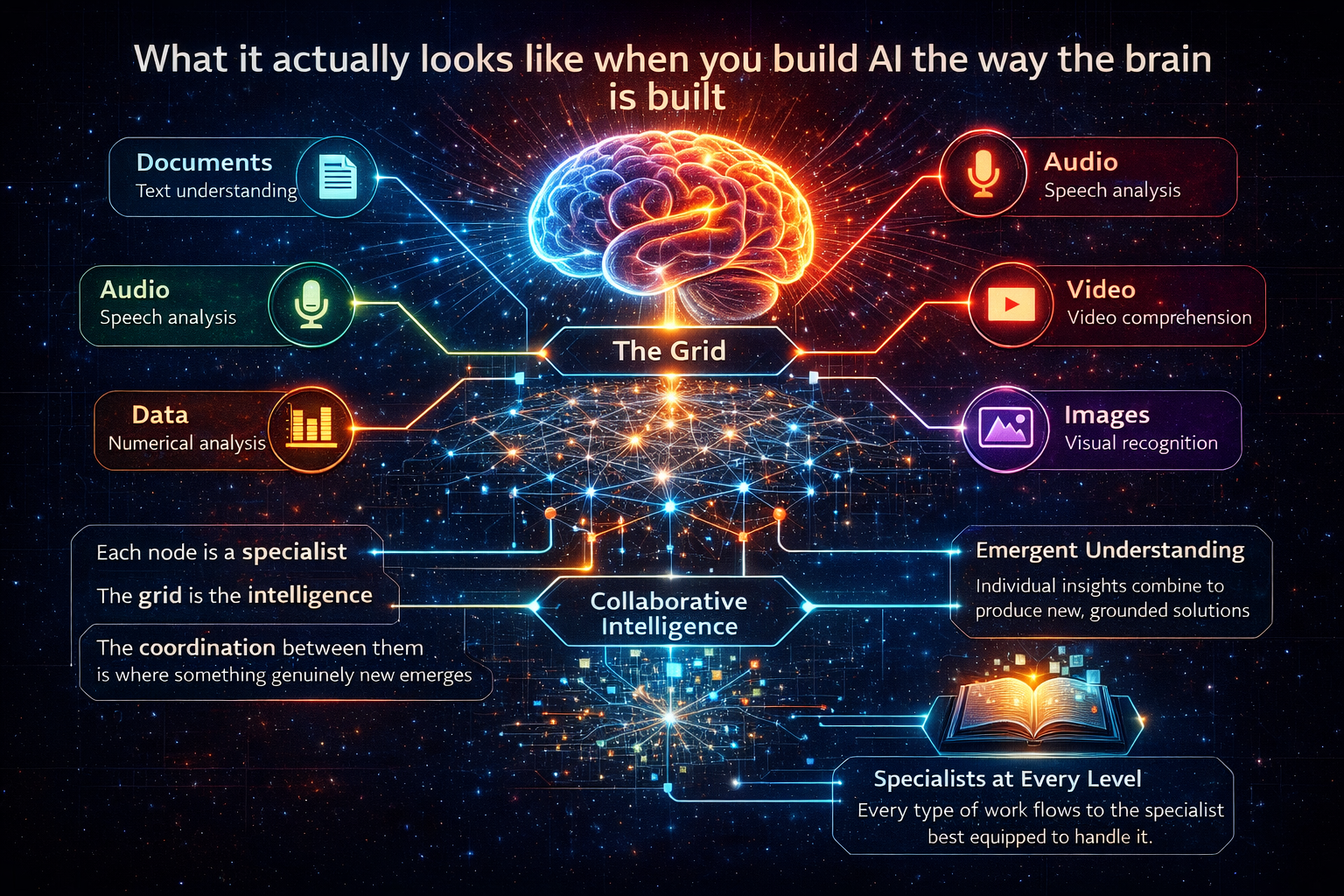
Building AI the way the brain actually works looks different. Picture it less like a server and more like a brain. Each part of the system — each node in the grid — is responsible for a specific kind of understanding: visual content, written language, voice, video, and the other ways an organization creates and communicates. But the point is not the individual parts. The point is what happens when they work together.
They coordinate. They share what they know. They arrive at answers that no single part could reach alone. Just as the regions of the brain do not each try to solve the whole problem, but contribute their piece to a shared understanding, the nodes of the grid each do their work and let the whole become greater than the sum.
“Each node is a specialist. The grid is the intelligence. The coordination between them is where something genuinely new emerges.”
Specialists at Every Level
For someone leading an organization, this means something practical: every type of work gets handled by a part of the system that was built for it. A document, a voice recording, a financial spreadsheet, a technical diagram — each flows to the part of the grid that understands it best, rather than being flattened into a one-size-fits-all conversation with a generalist.
The system also holds a living memory of the organization itself — its documents, decisions, conversations, and accumulated knowledge — organized in a way that each specialist can draw on. When the part of the system that understands visual content and the part that understands written language work together on a complex question, they are both drawing from the same deep pool of organizational knowledge. The answer they produce is grounded in who the organization actually is, not in what some external system thinks organizations in general are like.
Long-Term Memory: Intelligence That Compounds
Here is one of the most important things that most AI conversations miss: a system that learns from your organization over time becomes something qualitatively different from one that does not.
The grid is designed to build long-term memory. Not a static archive, but a living understanding that grows with every interaction. The part of the system serving your finance team in a year will have absorbed a year’s worth of how your finance team thinks, what they ask, what they care about, how they define terms, and what kinds of answers actually help them. That accumulated understanding cannot be purchased from an outside provider. It cannot be replicated by a system that has never worked with your organization. It belongs entirely to you.
This is what Hawkins described as the defining feature of intelligent systems: they do not just retrieve information. They build models. They develop genuine familiarity. They get better at understanding a domain the longer they are embedded in it. The grid is built to do exactly that — not as a feature, but as a first principle.
From Tool to Presence: Connected, Skilled, and Proactive
The moment the system stops waiting to be asked
There is a meaningful difference between an AI you use and an AI that works with you. The first waits to be asked. You go to it when you have a question, you get an answer, you move on. It is reactive, useful, and passive. Most AI today falls into this category.
The second does something different. It is aware of what is happening. It connects across the tools and workflows the organization already uses. And it acts — not because it was told to in that moment, but because it understands what the organization needs and has developed the judgment to help without being prompted.
Getting from the first to the second requires two things that no one in the on-premises space has fully built yet: deep connections into the organization’s existing systems, and the ability to take meaningful action within them.
Staying Connected to What Is Actually Happening
The grid’s long-term memory holds what the organization knows. But an intelligent system also needs to know what is happening right now. What projects are in flight. What conversations are taking place. What changed today. What is overdue.
By connecting into the tools an organization already uses — the places where work actually happens, where teams communicate, where decisions get made — the grid stays aware of the organization’s current state, not just its history. The combination of deep institutional memory and real-time awareness is what allows the system to move from answering questions about the past to acting meaningfully in the present.
From Awareness to Action
Awareness without the ability to act is just observation. The second layer — what we think of as skills — is what gives the grid genuine agency.
A grid with skills does not just flag that a deadline is at risk. It surfaces the relevant history, identifies who needs to know, and prepares the right communication. It does not just notice an unusual pattern in organizational data. It traces it, contextualizes it against what the organization knows, and brings it to the right person’s attention at the right moment. The system is not waiting to be asked. It is keeping pace with the work.
“Once the grid is connected to what is happening and has the ability to act on it, it stops being a tool you use and becomes something that works alongside you.”
Proactive Intelligence: The Brain’s Most Underrated Feature
Here is something most people do not realize about how the brain works: it is not primarily reactive. It is predictive. The brain is constantly building a model of what is about to happen — not just what has already occurred — and positioning itself to respond before events fully unfold. That anticipation is a large part of what makes human intelligence feel effortless in familiar situations.
A grid built on these principles works the same way. It learns the rhythms of the organization. It recognizes when familiar patterns are playing out. It begins to surface what will be needed before the need is fully articulated. The right information appears before the question is asked. The right people are looped in before the situation becomes urgent.
This requires everything working together: specialized nodes that each understand their domain, a shared memory of the organization’s knowledge and history, real-time awareness of what is currently happening, and the ability to act. Each piece is necessary. The intelligence that emerges when they are all in place is something different in kind, not just in degree, from the AI systems most organizations are using today.
At that point, the grid is no longer infrastructure. It is a presence — a self-directed intelligence that knows the organization, watches over it, and works to advance its goals without needing to be asked at every step.
Writing Your Own Ending
Science fiction is, at its best, a tool for examining choices before they are made. The AI future is not written. And the choice of what shape intelligence should take — one enormous all-purpose mind or a coordinated collection of specialists — is a choice organizations are making right now, often without realizing it.
Hawkins gave us the theoretical map. The brain is not a pipeline. Intelligence is not a single, all-knowing system. It is a community of specialists, coordinated toward a shared understanding. Organizations that build AI to reflect that reality — locally grounded, domain-specific, continuously learning, growing more valuable over time — are building something that deepens the longer it runs. Something that genuinely belongs to them.
The sci-fi future arrived. It just looks less like a single HAL 9000 and more like a thousand specialists — each doing their part, each making the whole smarter than any one of them could be alone.
“The sci-fi future arrived. Which story you’re living in depends on the architecture you choose to build.”
Own your AI. Own your intelligence. Gridlight — on-premises AI for organizations that refuse to be tenants.